"Age matters enormously for children’s digital lives, but as our new report clearly shows, so does socioeconomic background. Looking only at the average child risks overlooking important and complex inequalities in opportunities, skills, support, and exposure to risk."
EUKO coordinator Prof. Elisabeth Staksrud (University of Oslo, Norway)

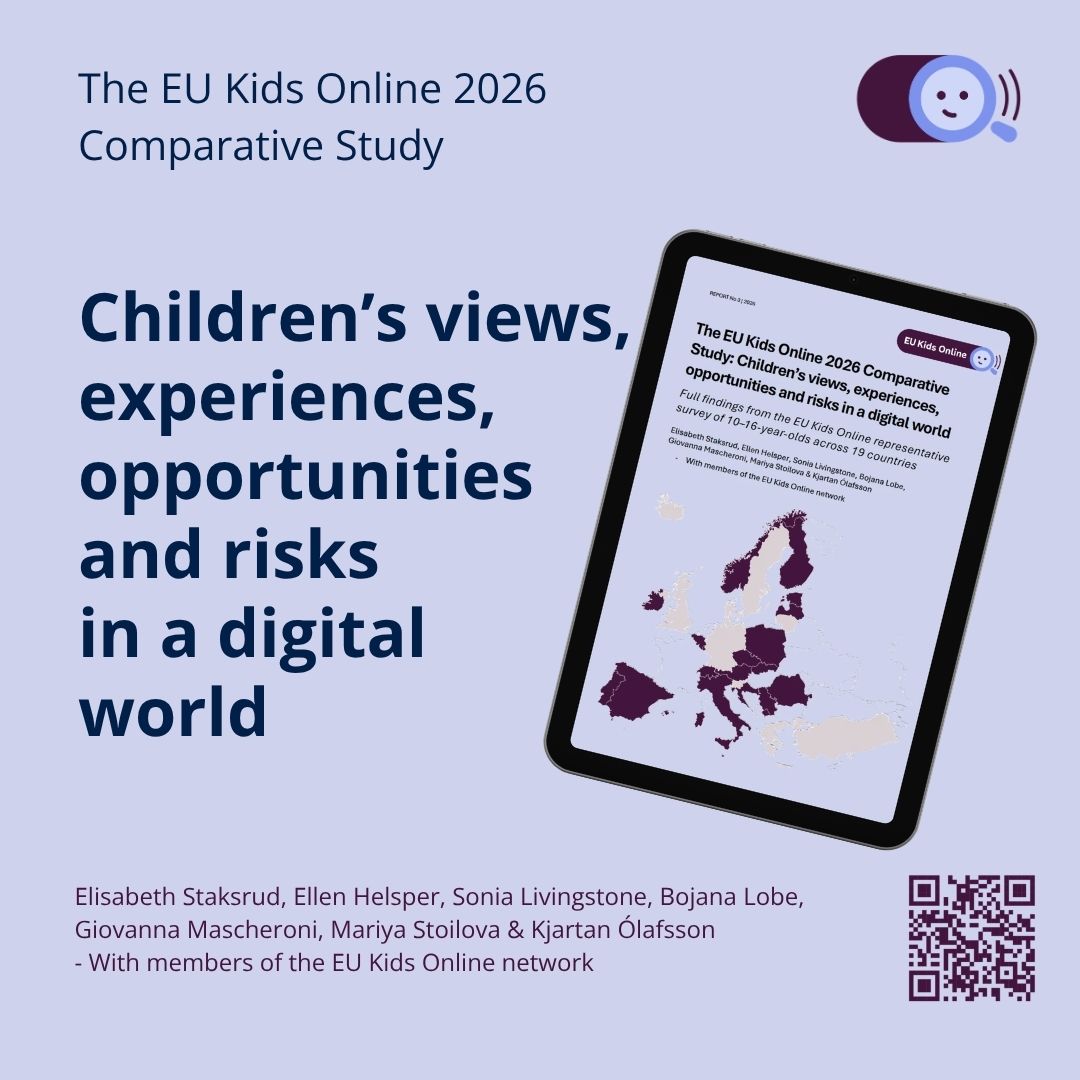
The report draws on representative comparative data from 28,465 children aged 10 to 16 from 19 European countries: Austria, Belgium, Croatia, Czechia, Estonia, Finland, Ireland, Italy, Luxembourg, Latvia, Malta, Norway, Poland, Portugal, Romania, Serbia, Slovakia, Spain, Switzerland
.png)
Access, opportunities and skills for participation
87% of children aged 10–16 use a smartphone or mobile phone to go online every day, compared with 33% using a desktop or laptop, 20% a tablet and 19% a games console.
58% of children use a smartphone to access the internet several times each day, while 28% do so daily or almost daily and 14% less often.
Girls report somewhat more frequent smartphone access than boys overall. Across the countries, 61% of girls compared with 55% of boys use a smartphone to go online several times each day.
.png)
For European children, the internet is an essential source of social connection, entertainment and learning.
Daily internet use for schoolwork has slightly increased since 2018, but large variations persist across countries and age groups.
Two in three European children are regular AI users. Children use AI mostly for educational and practical reasons, while creative and potentially risky uses, such as advice-seeking, remain less common, though more common in some countries.
.png)
Worries, safety and risk of harm
Many children feel capable of dealing with online challenges, but feelings of online safety are unevenly distributed, particularly among girls and socioeconomically disadvantaged children.
A majority of children (62%) say they know what to do when someone behaves online in a way they do not like, yet fewer than half (48%) say they feel safe online.
Face-to-face victimisation remains more common than online victimisation. Overall, 29% reported face-to-face experiences compared with 17% who reported online experiences.
.png)
Children report encountering a range of potentially harmful online content. Gory or violent images are the most commonly reported category (40%), followed by content about ways to be very thin (39%) and ways of physically harming or hurting oneself (37%). Suicide is the least commonly reported of the categories analysed (25%).
Experiences of excessive use are still limited: most children experience no aspects of excessive use and next to none experience all of the criteria.
Exposure to hateful messages is relatively common but varies considerably between countries. Across the 19 countries, 30% of children report encountering hateful messages at least every month, 27% hardly ever, and 43% never.

Support, enabling and regulation
Over three-quarters of 10– to 16-year-olds can discuss upsetting things with their parent or caregiver. However, 22% say they find this difficult – more often those from medium or low socioeconomic status homes.
Parental enabling mediation activities have decreased rather than increased since 2020 on key indicators: parents are now less likely to talk to their child about what they do online – 50% in 2025, down from 66% in 2020.
49% of children report a mobile phone ban in school, while 51% don’t: 28% both have the rule and agree with it, while 21% have the rule but disagree.

Views and worries about the digital future
The most widespread digital worries are related to the impact of AI on the present and the future. Specifically, 41% of the respondents express high or some concern that AI-based technologies damage the environment and consume too much natural resources.
54% of European children say they do not think it is okay for companies to track their online behaviour and use this data to send them personalised adverts.
Read the report here
Reference: Staksrud, E.; Helsper, E.; Livingstone, S.; Lobe, B.; Mascheroni, G.; Stoilova, M.; Ólafsson, K. - with members of the EU Kids Online network (2026): The EU Kids Online 2026 Comparative Study: Children’s views, experiences, opportunities and risks in a digital world Full findings from the EU Kids Online representative survey of 10–16-year-olds across 19 countries (EUKO Report No 3)